Historic features · Featured site

The Bar Harbor Water Company

In the summer of 1873 typhoid killed thirteen guests at a Bar Harbor hotel. Within a year the village had piped water from Duck Brook, and within fifteen it was drinking straight from Eagle Lake. The works left a trail of ruins between the lake and the town, and the fight to keep that water clean helped start Acadia National Park.

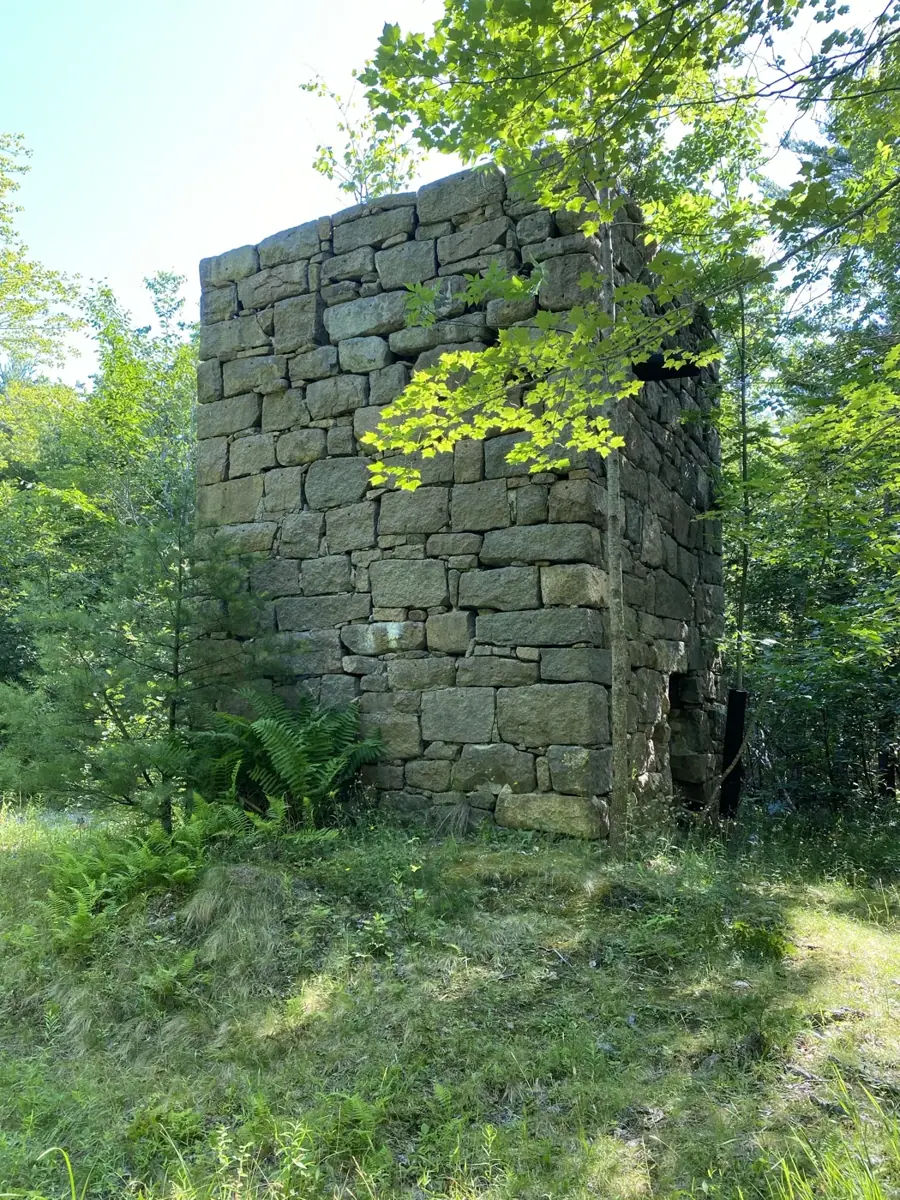
Square tower of fitted granite blocks in a sunny clearing among young trees
The 1887 stone standpipe tower below Eagle Lake, 21 Jul 2020
Why a water company

A bad well and a wooden flume

In August 1873 typhoid broke out at the Bay View House and thirteen guests died; scarlatina followed at the Rodick House. Dr. William Morton traced the trouble to a well fouled by sewage. For a resort that lived on its summer visitors, it was a disaster.

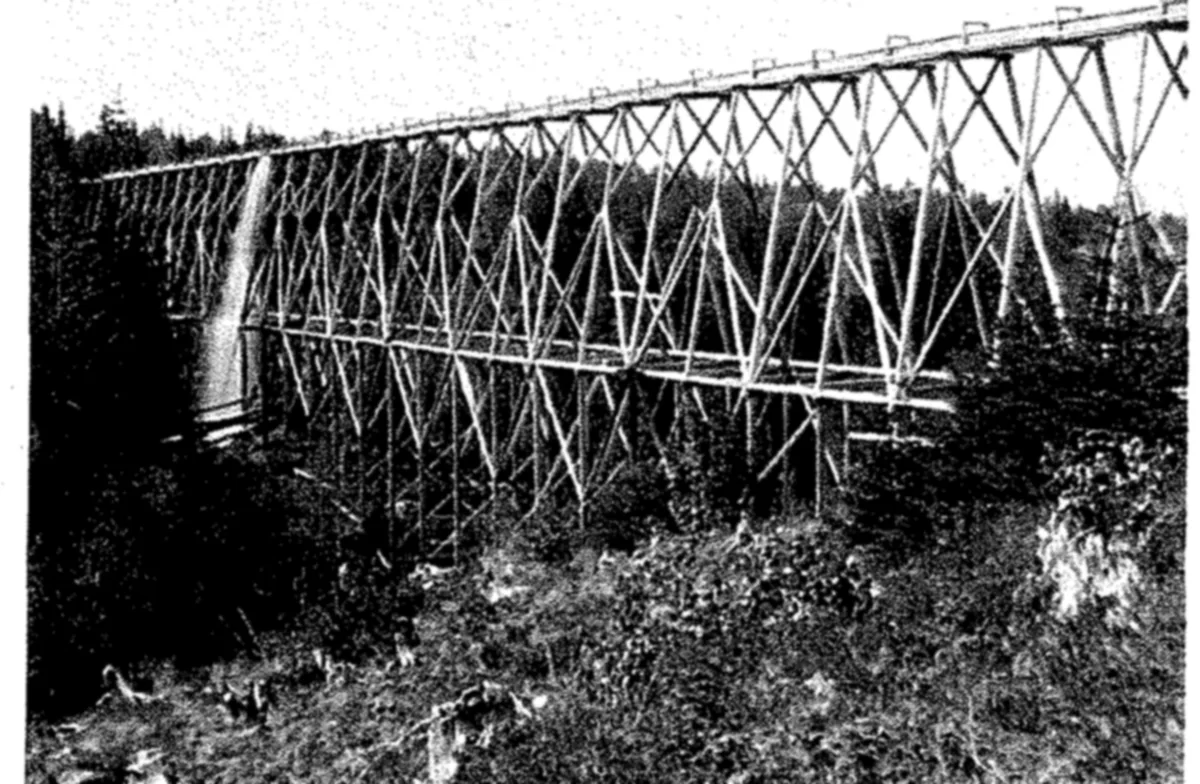
The Rodick family, who owned the Rodick House, chartered the Bar Harbor Water Company on 10 February 1874 with the Higgins family, Alfred Conners and Edwin Des Isles, who designed the flumes. Work began on 10 May, and the system was dedicated on 4 July 1874, sixty-five days later: a mile and a half of open wooden flume from Duck Brook, carried across the valley on a tall trestle, to a 190,000-gallon reservoir on Scott's Hill.

This page draws on Peter Morrison's History of the Bar Harbor Water Company, 1873–2004, prepared for the National Park Service in 2005, the company and land papers in the Library, and field points recorded between 2009 and 2022.

Old photograph of a tall timber trestle carrying a flume across a wooded valley
The company's aqueduct across the Duck Brook valley, in use 1874–1884. From a stereoscopic pair, photographer unknown. Courtesy of the Maine Historic Preservation Commission.
Eagle Lake to the village

Where the works stand

The numbered pins mark four places: the Eagle Lake works, the dams at New Mills Meadow, the tanks on Great Hill and the Livingston foundation. Smaller dots are related field points, and the old roads and pipe paths are drawn over the 1942 USGS map. Click any point for its field note.

Structure or ruin Road, path or pipeline note Cairn
1

The Eagle Lake works

Stone tower 1887–88 · brick gatehouses 1896 and 1933 · sand filters 1905–06

The Rodicks moved the supply again and again: in 1881 to a new reservoir on Cunningham's Hill, and in 1884 to iron pipe and a set of dams at New Mills Meadow. After the drought of 1886, summer residents formed a rival Eden Water Company and took the quarrel to the legislature in Augusta, with James G. Blaine testifying for them. That winter the Rodicks built a stone standpipe just below Eagle Lake and laid 16-inch and 24-inch pipe to it (the 24-inch is marked "1888"). From then on the village drank straight from the lake, and every earlier reservoir was abandoned.

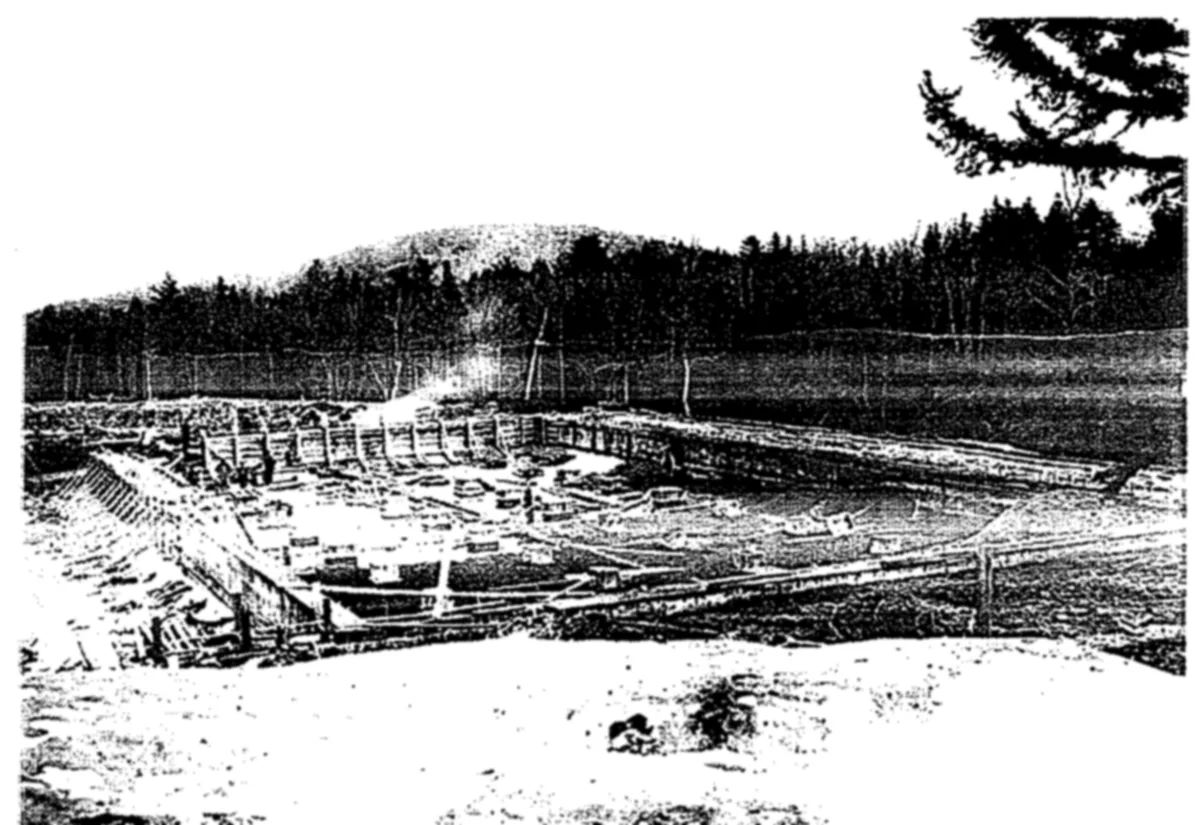
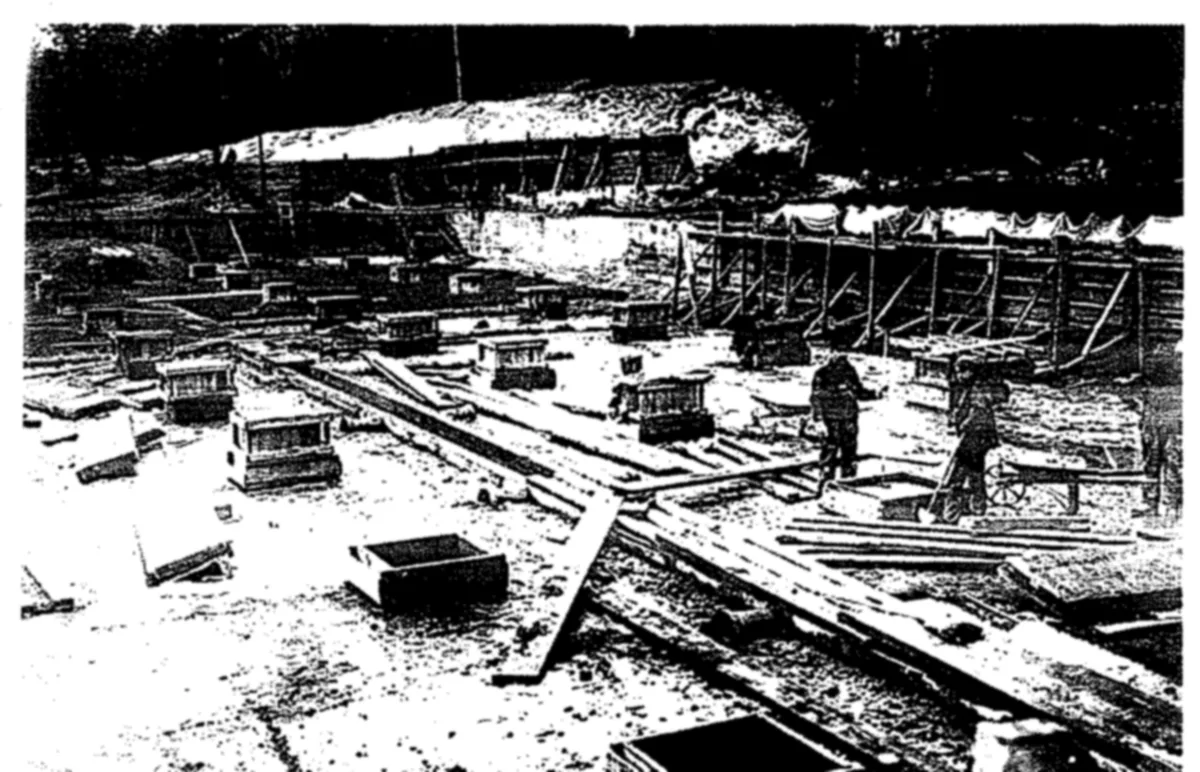
In November 1893 the Rodicks defaulted and the Eden company's men took over; Fred C. Lynam was president until his death in 1942. The new board hired a real engineer, Freeman C. Coffin of Boston. They raised the dam at the outlet, built a brick gatehouse in 1896, and around 1897 put a water meter at the pipe junction, possibly inside the disused stone tower. When an algae bloom spoiled the taste of the water in 1905, the company built sand filters between the lake and New Mills Meadow: two quarter-acre concrete beds, a secondary filter and an aeration tank, never roofed. They were retired in 1932–33, when chlorine replaced them, and their lot was deeded to John D. Rockefeller Jr.

Found in the field · 2010 to 2021

  • The stone tower, its wooden door still inside Show on map
  • The sediment ponds, which are the 1905–06 sand filters Show on map, and the road down to them Show on map
  • The access road to the old works Show on map and the "Water Tower Road"
  • The pump house by the outlet dam Show on map
  • A flat area by the outlet that may be the Lake House site Show on map
  • Exposed galvanized pipe on the Brewer Mountain road Show on map, and the pipe crossing Duck Brook Show on map
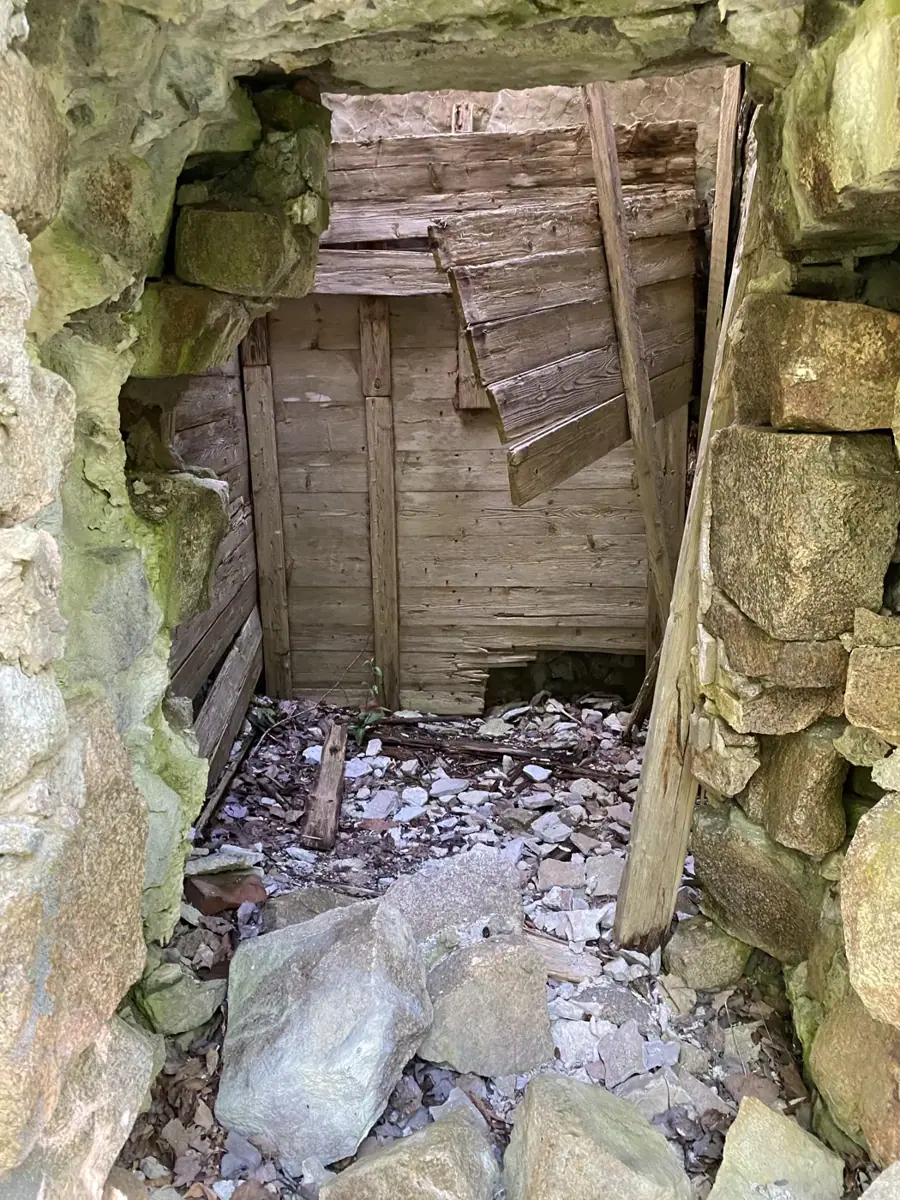
Inside the stone tower: granite walls around a broken wooden door and fallen rubble
Inside the stone tower, 21 Jul 2020
Peter Heilakka standing in the doorway of the stone tower
Peter Heilakka in the doorway of the stone tower, 24 Jul 2015
2

New Mills Meadow and Duck Brook

Flume 1874 · iron pipe and dams 1884 · chlorination house 1931–33

In 1884 the wooden flume gave way to 12-inch cast-iron pipe laid along the east bank of Duck Brook, fed by three dams, a reservoir and a bypass canal at New Mills Meadow. The tallest dam stood near today's Duck Brook carriage-road bridge; split granite blocks seen through the arch may be part of it. In 1884 a screen broke and eels clogged the pipes. A survey in 1899 found the pipe lying 20 to 100 feet off its right-of-way, and the landowners' suit was not settled until 1901.

The 1884 line is still there, lying on the ground. In 1997 it froze and split, and about 3,000 feet were replaced with polyethylene. New Mills Meadow stayed the junction of the system: in 1931–33 a chlorination house went up here, and the venturi meter was moved down from the stone tower. Morrison wrote that the Rodicks' do-it-yourself engineering left the Duck Brook valley "littered with the ruins of their successive experiments", none of them state of the art, "but they all make visually impressive ruins today."

Found in the field · 2009 to 2022

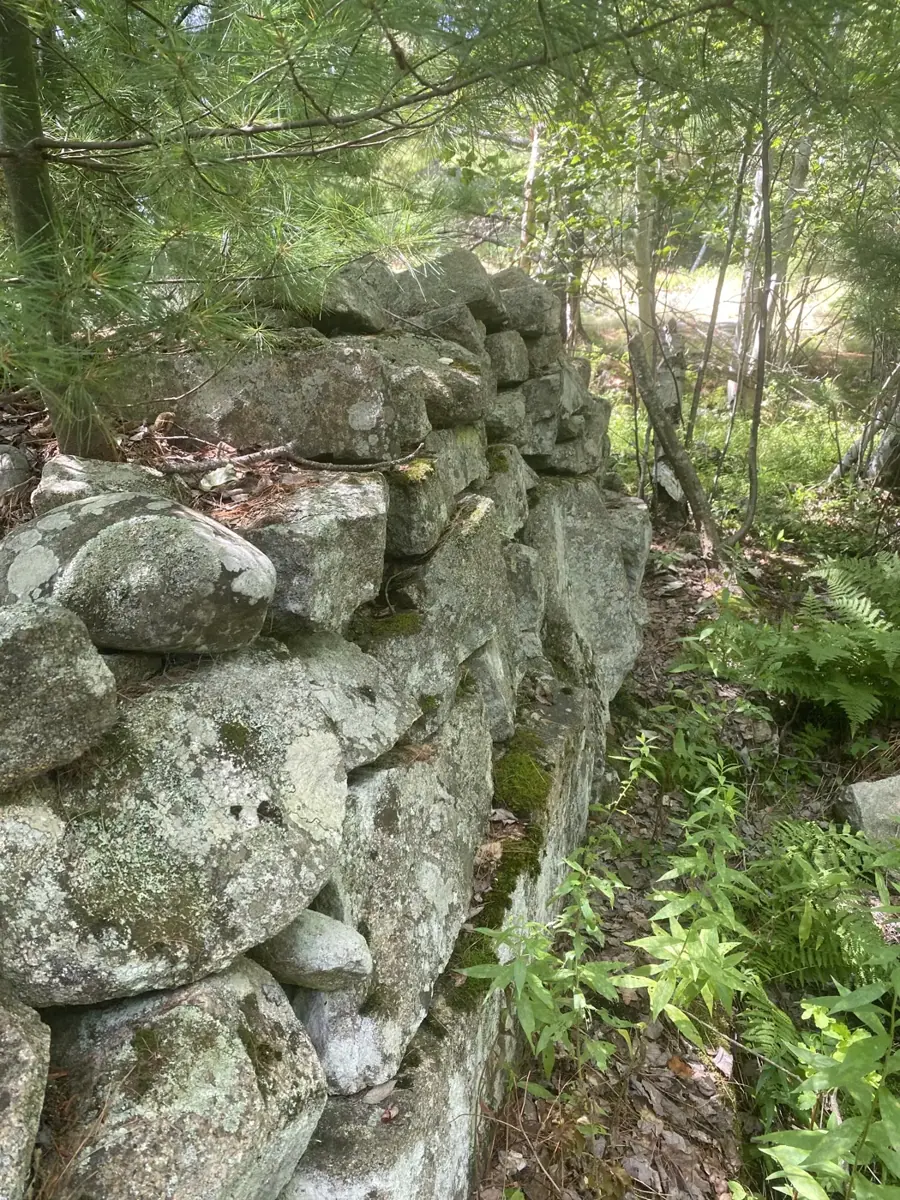
Mossy dry-laid stone wall beside a woodland path
Old mill foundation at New Mill Meadow, 26 Jul 2022
3

The reservoirs on Great Hill

Pipe around the hill 1895 · concrete reservoir 1901 · iron tank 1935–36 · concrete tank 2001

In 1895 the new company laid 14-inch pipe around the north ridge of Great Hill, through a deep cut in the bedrock and behind long retaining walls, most likely alongside the New Eagle Lake Road that is now Duck Brook Road. Lawn sprinklers kept summer demand high, so in 1901 Coffin built a 700,000-gallon reservoir of Portland cement concrete above the cut, filled by gravity at night. More big pipe followed in 1904 and 1909, and after that the supply never needed enlarging again.

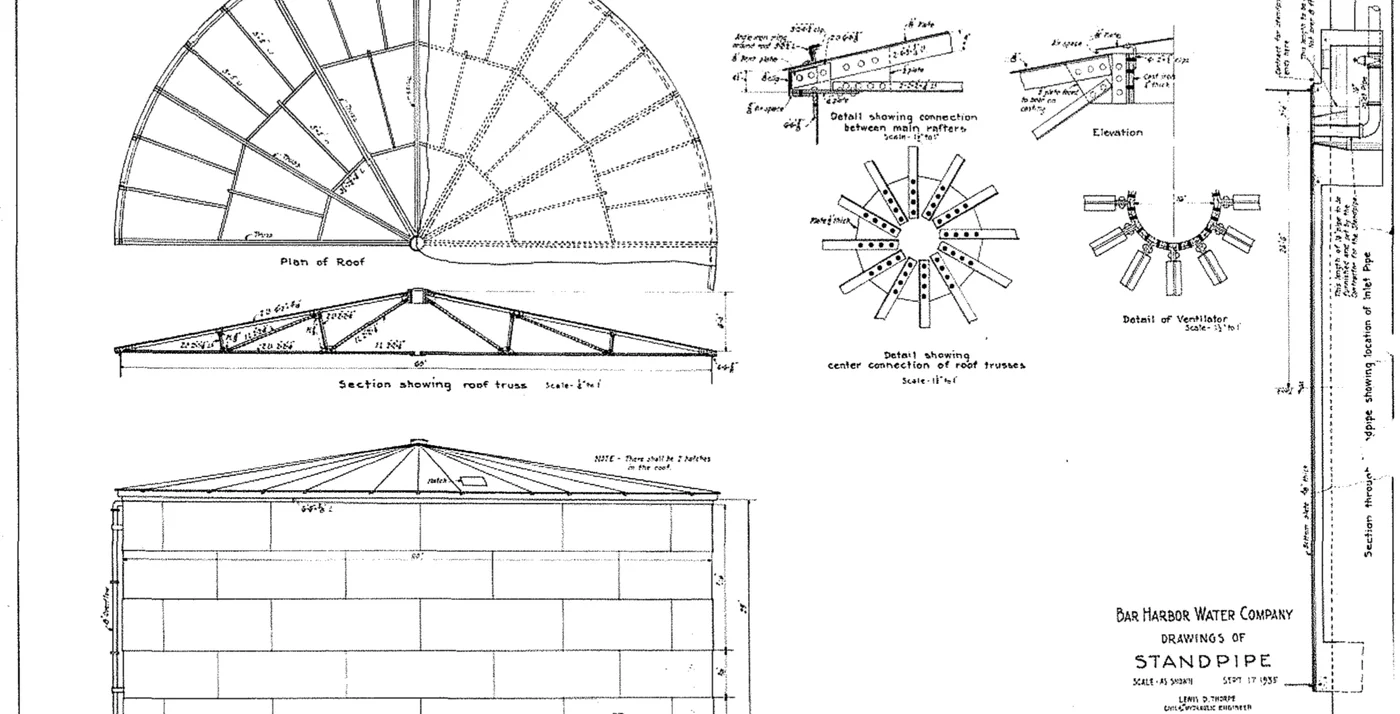
The reservoir was given up around 1928. Its replacement was a 500,000-gallon iron standpipe higher on the hill, above New Mills Meadow, drawn by Lewis D. Thorpe in September 1935 and finished in 1936. Its base is higher than the lake, so electric pumps in a brick addition to the chlorination house fill it at night. A second, concrete tank of 500,000 gallons was built near it in 2001. In 2000 the Town of Bar Harbor bought the company, after 126 years in private hands.

Found in the field · 2009 and 2021

Engineering drawing of a round iron standpipe with its roof trusses, dated 17 September 1935
Drawings of the Great Hill standpipe, Lewis D. Thorpe, engineer, 17 Sep 1935. Courtesy of the Bar Harbor Water Company, via Morrison (2005).
4

The Livingston foundation

Cottage started 1910 · bought out 1911 · land to Sieur de Monts National Monument 1916

For years the only buildings on Eagle Lake were the small Lake House hotel at the outlet, the Curran House (bought and razed by the company shortly before 1900), the Green Mountain Railroad's base station and the Brewer ice house. Then Philip Livingston started a cottage on the shore, and in January 1910 the directors resolved, for the first time on record, to protect the whole watershed.

A research note in the Library tells how the directors, all summer people, met in New York and sent George B. Dorr to Bar Harbor; the company's secretary went to Florida to see Livingston, and the company bought him out at his cost. The company itself could not get powers of condemnation, so Dorr had them granted to the Hancock County Trustees of Public Reservations instead. The pattern was set: the water company paid, the Trustees held the title. In July 1910 they bought 75 acres from A. Stroud Rodick, in January 1911 six more lots including Livingston's, and by 1917 the company reported the watershed secured at a cost of $71,804.63. In 1916 the Trustees' land became Sieur de Monts National Monument, the core of Lafayette National Park in 1919, and Dorr, then a director of the water company, became its first superintendent.

Livingston went on to build Fairview on Eden Street; it later belonged to Mary Roberts Rinehart and was lost in the 1947 fire. As the research note says, "the abandoned foundation at Eagle Lake still stands in the woods."

Found in the field · July 2018

Then

The works in old photographs

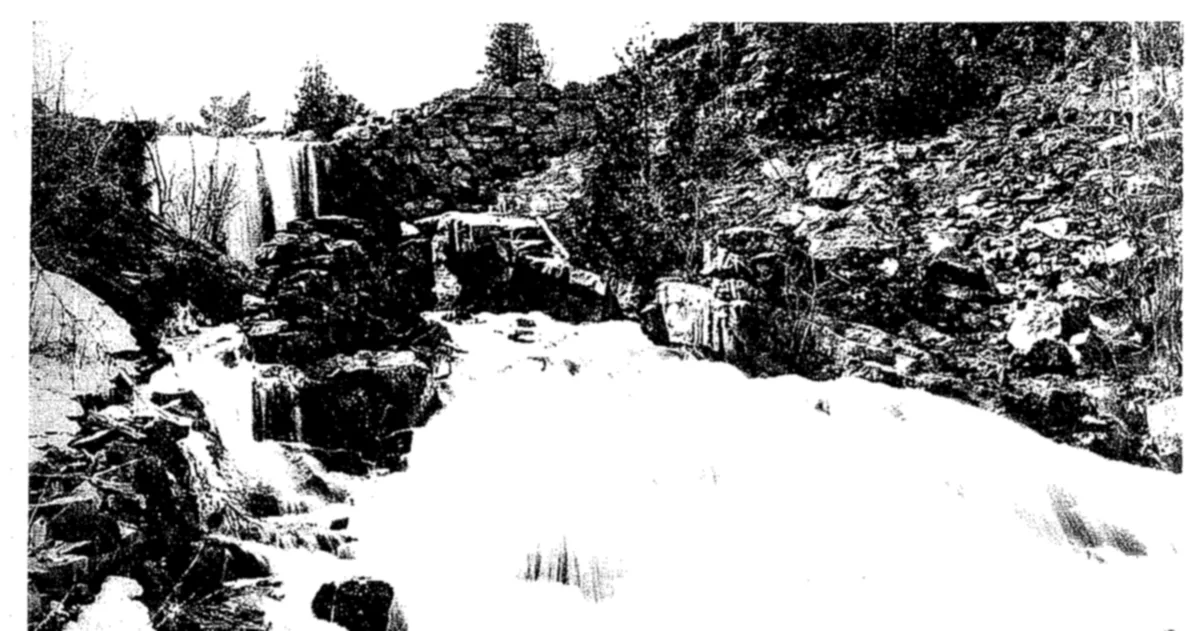
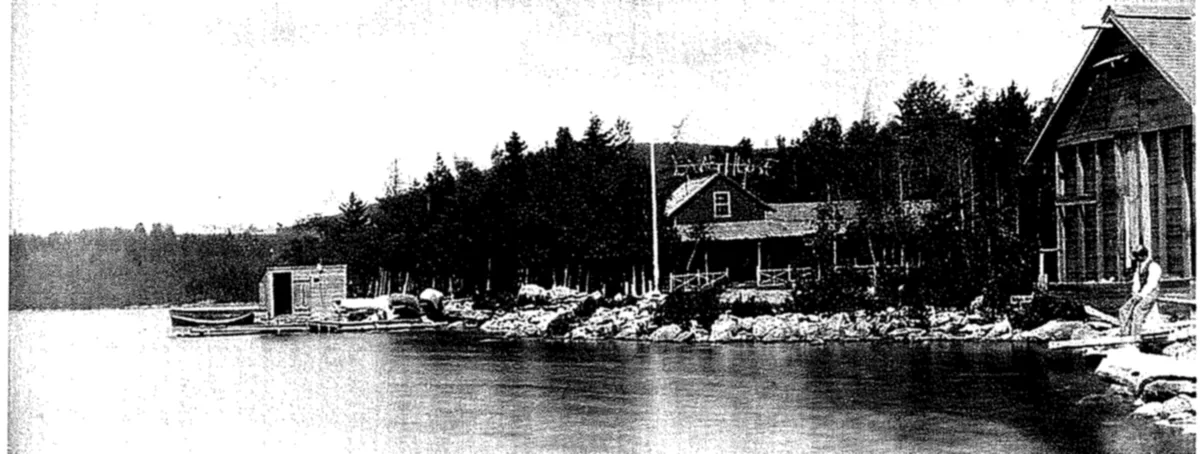
Images from Morrison's report. The originals were scanned for print, so they are soft at screen size.

Water pouring over a broken stone dam among boulders
"Duck Brook Falls", the only known image of the dam that formed the reservoir below New Mills Meadow, already partly in ruinsW. H. Sherman, Bar Harbor
Small hotel and boathouse on the shore of a lake
The Lake House at the Eagle Lake outlet, about 1880Photographer unknown
Wide excavation with timber forms for concrete filter beds
Sand filters under construction, 1905–06
Workmen among concrete boxes and planks inside a filter bed
Sand filters under construction, 1905–06
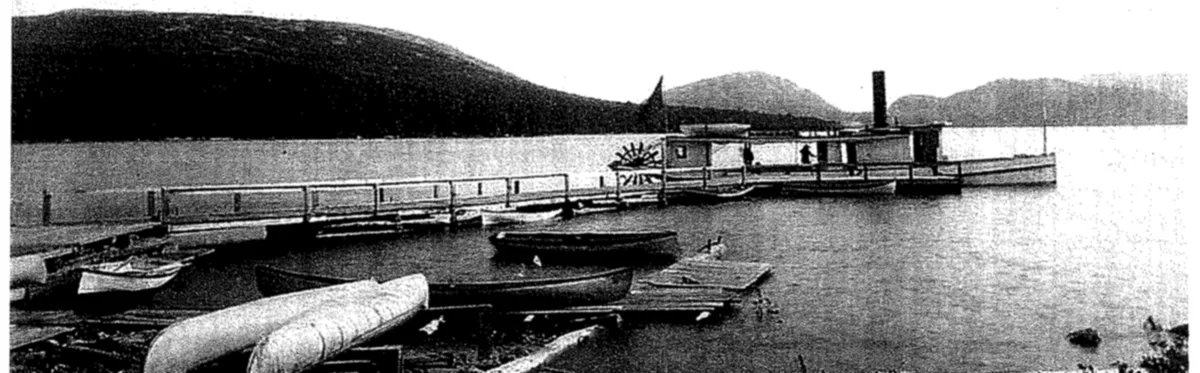
Small steamboat at a long wharf on a lake with mountains behind
The steamboat Wauwinnet, which carried passengers from the Lake House to the Green Mountain RailroadPhotographer unknown

Courtesy of the Maine Historic Preservation Commission, via Peter Morrison, History of the Bar Harbor Water Company (2005).

Timeline

A century and a quarter of water

  1. Aug 1873Typhoid at the Bay View House; thirteen guests die.
  2. 4 Jul 1874Water from Duck Brook reaches the village by wooden flume, 65 days after work began.
  3. 1881A higher reservoir on Cunningham's Hill doubles the pressure; Scott's Hill is abandoned.
  4. 1884Iron pipe replaces the flume, with three dams and a reservoir at New Mills Meadow.
  5. 1887–88The stone standpipe and new pipe bring water straight from Eagle Lake.
  6. Nov 1893The Rodicks default; the Eden Water Company's directors take over.
  7. 1895–96Pipe around Great Hill, a new office on Main Street, a brick gatehouse at the lake.
  8. 1901The 700,000-gallon concrete reservoir on Great Hill.
  9. 1905–06Sand filters built after an algae bloom spoils the taste.
  10. 1910–11The Livingston cottage scare; watershed land bought for the Trustees of Public Reservations.
  11. 1916The Trustees' land becomes Sieur de Monts National Monument, Lafayette National Park in 1919.
  12. 1931–36Chlorine replaces the filters; new gatehouse; iron standpipe on Great Hill.
  13. 2000The Town of Bar Harbor buys the company.
  14. 2005Morrison finds the system eligible for the National Register as a historic district.
From the archive

History, deeds and reports

The documents behind this story, all in the Library.

Other island water works turn up in the field notes too, among them an abandoned water company building and reservoir dam near Lower Hadlock Pond Show on map, a Seal Harbor Water Company building on its pipeline Show on map, and the Long Pond pump house in Southwest Harbor Show on map. Not far from the stone tower is the second Bar Harbor pest house, which in 1911 the town judged to have no good water, although the main pipeline ran about 100 yards away.

Walk lightly

Eagle Lake is still Bar Harbor's drinking water and swimming is not allowed, and parts of the works are active town property, so keep out of fenced areas and buildings. The ruins are inside Acadia National Park: look, photograph and leave everything as you find it. The 1884 pipe on the ground is a part of the record, and Morrison recommended it be disturbed as little as possible.